
Smart Africa & FAO Innovate Africa Challenge 2026 – AI for Climate-Smart Agriculture
Food and Agriculture Organization of the United Nations (FAO) & Smart Africa Secretariat
About This Opportunity
STI portal networkMenuToggle navigation
Challenge group
Innovate Africa Challenge (3rd Edition)
Primary tabs
679
members
0
events
1
topic
156
innovation ideas
See group information
Group managers
Nelya Yahodynets
Junior Communication and Community Manager Specialist • FAO
Default profile image
Fruit Hailu
Henry Burgsteden
Senior Innovation Officer • FAO
Default profile image
Soumia Khyat
Graphic Design and Communication Intern • FAO
Default profile image
Tafadzwa Jowa
Project Manager • Smart Africa
Olivier Gakwaya
Project Manager • Smart Africa
Angelique UWIMANA Food and Agriculture Organization of United Nations (FAO)
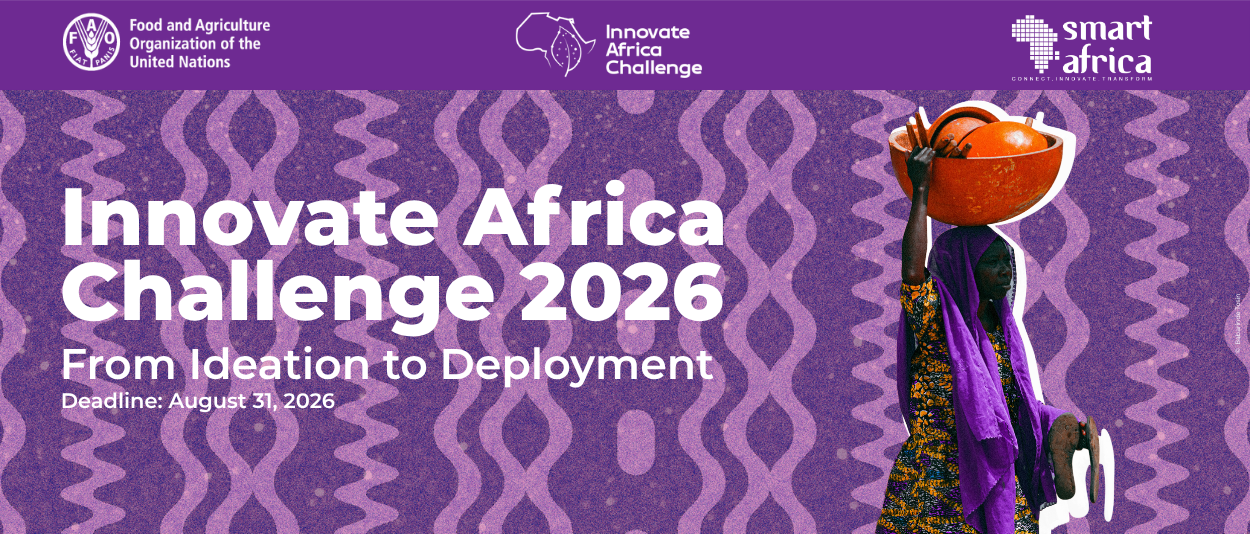
The Innovate Africa Challenge (3rd Edition), organized jointly by the Food and Agriculture Organization of the United Nations (FAO) and the Smart Africa Secretariat, is a continental initiative aimed at accelerating the deployment of Artificial Intelligence (AI) solutions to address climate and agricultural challenges in Africa. The 2026 edition is themed “From Ideation to Deployment”, emphasizing the transition from innovative concepts to practical, scalable solutions that deliver measurable benefits to farmers.
Why the Challenge Matters
Africa’s agrifood systems face significant challenges, including:
Climate variability and increasing climate shocks
Food insecurity and declining natural resources
Limited access to timely agricultural information
Low adoption of digital technologies.
Fragmented agricultural data systems and skills gaps.
Persistent inequalities affecting smallholder farmers and rural communities.
At the same time, advances in AI, digital agriculture, and data-driven technologies offer major opportunities to improve productivity, resilience, sustainability, and market access. However, many promising solutions remain at the pilot stage and are rarely integrated into national agricultural systems or deployed on a scale.
Previous editions of the Innovate Africa Challenge demonstrated the potential of AI to support climate action and agriculture by:
Mobilizing innovators from more than 40 African countries
Promoting AI-powered solutions for climate resilience
Deploying AI-enabled weather stations that support farmers with improved information and decision-making tools
Despite these achievements, many innovations have been developed without sufficient validation in African smallholder farming contexts, limiting their large-scale adoption and impact.
What This Edition Aims to Achieve
The Third Edition seeks to identify and support a proven AI-driven solution for Climate-Smart Agriculture and deploy it within a Smart Africa Member State. The selected solution will be implemented in partnership with:
National ministries responsible for Agriculture, ICT, and Innovation
The Smart Africa Secretariat
FAO country offices and technical experts
The challenge aims to demonstrate real-world impact for farmers while generating lessons and evidence that can support replication and scaling across Africa. The initiative envisions an Africa where agrifood systems are resilient, adaptive, and prosperous, with digital technologies and AI delivering tangible benefits to farmers, communities, and ecosystems across the continent.
Objective
The primary objective is to identify, support, and deploy one proven AI-based solution that strengthens climate resilience and improves productivity within African agrifood systems. The challenge also seeks to foster collaboration among governments, innovators, development partners, and agricultural stakeholders to ensure that successful innovations can scale and create lasting impact
Specifically, the challenge seeks to:
Surface and validate mature AI solutions addressing climate-smart agriculture using African agricultural and climate data, while promoting responsible AI, data governance, and data sovereignty principles;
Support a leading solution through deployment in a Smart Africa Member State, in collaboration with the host ministry and FAO;
Demonstrate measurable improvements in farmer decision-making, productivity, or climate resilience;
Strengthen collaboration and ecosystem linkages among innovators, ministries, FAO country offices, the private sector, and other key stakeholders across Member States, to ensure sustainability and long-term partnerships,
Generate evidence and a replicable model to inform the scale-up of AI for climate-smart agriculture across the continent, including pathways for scale-up, sustainability and long–term sustainability and long–term or continued capacity development.
Expected outcome
Deployment of a Scalable and Context-Validated AI Solution One (1) Proven AI-driven solution customized to African agricultural realities will be deployed, validated, and demonstrated in real-world settings. This will result in measurable improvements in farmers' decision-making, productivity, and climate resilience, laying a clear foundation for wider adoption across Member States.
Strengthened Ecosystem and Multi-Stakeholder Collaboration The initiative will catalyze stronger partnerships among innovators, government ministries, FAO country offices, the private sector, research institutions, and farmer organizations. By fostering an enabling environment and ecosystem linkages, the collaboration will help break down silos, promote knowledge exchange, and build capacity for sustained digital transformation in agriculture.
Evidence Generation and a Replicable Model for Scale-Up The challenge will generate robust evidence and lessons learned from the deployment process, creating a replicable model for scaling AI innovations in climate-smart agriculture across the continent. This will inform policy, guide investment, and accelerate the adoption of responsible AI solutions, amplifying impact for African farmers and food systems.
Scope of the Challenge
The Innovate Africa Challenge will support a diverse portfolio of start-ups and technology providers in deploying and demonstrating proven AI solutions that:
Deliver climate and agronomic decision support to farmers, agricultural institutions, or extension service providers;
Operate effectively using African agricultural, climate, and remote-sensing data;
Generate actionable, explainable outputs suitable for practical use by farmers, extension agents, or ministries;
Seamlessly integrate with national agricultural data systems, digital platforms, or extension channels to ensure sustainability and scalability.
Primary Focus Areas
The challenge will place particular emphasis on solutions addressing:
Precision agriculture and input optimization; to improve resource efficiency and reduce. environmental impact;
Crop yield prediction and forecasting; to support proactive planning and food security;
Pest and disease surveillance, detection, and early warning; enabling timely responses and minimizing losses;
Climate risk modeling and adaptive decision support, to strengthen resilience to climate variability and shocks; and
Water and natural resource optimization.
Deployment and Validation:
Deployment and validation activities will be prioritized in selected Smart Africa Member States, specifically Rwanda, Kenya, Ghana, Malawi, and Uganda, in alignment with FAO country office presence and national agricultural priorities. The challenge’s portfolio approach and multi-track design will also encourage ecosystem collaboration, knowledge sharing, and multi-stakeholder partnerships to maximize the adoption and impact of AI-driven climate-smart agriculture solutions across the continent.
Expected Solution Capabilities
Participating startups are expected to demonstrate solutions that produce reliable, actionable outputs for farmers, extension services, or agricultural institutions.
The proposed solution should demonstrate the ability to operate effectively in environments characterized by:
Smallholder and informal farming systems;
Partial, incomplete, or low-frequency datasets;
Mobile-first and low-connectivity settings;
Multi-language and heterogeneous data environments;
Diverse agro-ecological zones and farming practices;
Integration with national extension and ministry systems.
Eligibility Criteria
- Must be a legally registered entity or eligible innovation team
- Must have at least two team members
- Must have an AI-driven solution for climate-smart agriculture
- Must have a Technology Readiness Level (TRL) between 3 and 6
- Must have a working, deployed or deployment-ready solution
- Must demonstrate technical validation, pilots, deployments or other evidence of operational experience
- Must demonstrate technical capacity to deploy the solution in a new country context
- Must comply with applicable data protection, privacy and responsible AI requirements
- Must demonstrate a pathway to financial sustainability and scale
- Preference is given to solutions serving smallholder farmers, including women and youth
Required Documents
- STI portal networkMenuToggle navigation
- Challenge group
- Innovate Africa Challenge (3rd Edition)
- Primary tabs
- 679
- members
- events
- 1
- topic
- 156
- innovation ideas
- See group information
- Group managers
- Nelya Yahodynets
- Junior Communication and Community Manager Specialist • FAO
- Default profile image
- Fruit Hailu
- Henry Burgsteden
- Senior Innovation Officer • FAO
- Default profile image
- Soumia Khyat
- Graphic Design and Communication Intern • FAO
- Default profile image
- Tafadzwa Jowa
- Project Manager • Smart Africa
- Olivier Gakwaya
- Project Manager • Smart Africa
- Angelique UWIMANA Food and Agriculture Organization of United Nations (FAO)
- The Innovate Africa Challenge (3rd Edition), organized jointly by the Food and Agriculture Organization of the United Nations (FAO) and the Smart Africa Secretariat, is a continental initiative aimed at accelerating the deployment of Artificial Intelligence (AI) solutions to address climate and agricultural challenges in Africa. The 2026 edition is themed “From Ideation to Deployment”, emphasizing the transition from innovative concepts to practical, scalable solutions that deliver measurable benefits to farmers.
- Why the Challenge Matters
- Africa’s agrifood systems face significant challenges, including:
- Climate variability and increasing climate shocks
- Food insecurity and declining natural resources
- Limited access to timely agricultural information
- Low adoption of digital technologies.
- Fragmented agricultural data systems and skills gaps.
- Persistent inequalities affecting smallholder farmers and rural communities.
- At the same time, advances in AI, digital agriculture, and data-driven technologies offer major opportunities to improve productivity, resilience, sustainability, and market access. However, many promising solutions remain at the pilot stage and are rarely integrated into national agricultural systems or deployed on a scale.
- Previous editions of the Innovate Africa Challenge demonstrated the potential of AI to support climate action and agriculture by:
- Mobilizing innovators from more than 40 African countries
- Promoting AI-powered solutions for climate resilience
- Deploying AI-enabled weather stations that support farmers with improved information and decision-making tools
- Despite these achievements, many innovations have been developed without sufficient validation in African smallholder farming contexts, limiting their large-scale adoption and impact.
- What This Edition Aims to Achieve
- The Third Edition seeks to identify and support a proven AI-driven solution for Climate-Smart Agriculture and deploy it within a Smart Africa Member State. The selected solution will be implemented in partnership with:
- National ministries responsible for Agriculture, ICT, and Innovation
- The Smart Africa Secretariat
- FAO country offices and technical experts
- The challenge aims to demonstrate real-world impact for farmers while generating lessons and evidence that can support replication and scaling across Africa. The initiative envisions an Africa where agrifood systems are resilient, adaptive, and prosperous, with digital technologies and AI delivering tangible benefits to farmers, communities, and ecosystems across the continent.
- Objective
- The primary objective is to identify, support, and deploy one proven AI-based solution that strengthens climate resilience and improves productivity within African agrifood systems. The challenge also seeks to foster collaboration among governments, innovators, development partners, and agricultural stakeholders to ensure that successful innovations can scale and create lasting impact
- Specifically, the challenge seeks to:
- Surface and validate mature AI solutions addressing climate-smart agriculture using African agricultural and climate data, while promoting responsible AI, data governance, and data sovereignty principles;
- Support a leading solution through deployment in a Smart Africa Member State, in collaboration with the host ministry and FAO;
- Demonstrate measurable improvements in farmer decision-making, productivity, or climate resilience;
- Strengthen collaboration and ecosystem linkages among innovators, ministries, FAO country offices, the private sector, and other key stakeholders across Member States, to ensure sustainability and long-term partnerships,
- Generate evidence and a replicable model to inform the scale-up of AI for climate-smart agriculture across the continent, including pathways for scale-up, sustainability and long–term sustainability and long–term or continued capacity development.
- Expected outcome
- Deployment of a Scalable and Context-Validated AI Solution One (1) Proven AI-driven solution customized to African agricultural realities will be deployed, validated, and demonstrated in real-world settings. This will result in measurable improvements in farmers' decision-making, productivity, and climate resilience, laying a clear foundation for wider adoption across Member States.
- Strengthened Ecosystem and Multi-Stakeholder Collaboration The initiative will catalyze stronger partnerships among innovators, government ministries, FAO country offices, the private sector, research institutions, and farmer organizations. By fostering an enabling environment and ecosystem linkages, the collaboration will help break down silos, promote knowledge exchange, and build capacity for sustained digital transformation in agriculture.
- Evidence Generation and a Replicable Model for Scale-Up The challenge will generate robust evidence and lessons learned from the deployment process, creating a replicable model for scaling AI innovations in climate-smart agriculture across the continent. This will inform policy, guide investment, and accelerate the adoption of responsible AI solutions, amplifying impact for African farmers and food systems.
- Scope of the Challenge
- The Innovate Africa Challenge will support a diverse portfolio of start-ups and technology providers in deploying and demonstrating proven AI solutions that:
- Deliver climate and agronomic decision support to farmers, agricultural institutions, or extension service providers;
- Operate effectively using African agricultural, climate, and remote-sensing data;
- Generate actionable, explainable outputs suitable for practical use by farmers, extension agents, or ministries;
- Seamlessly integrate with national agricultural data systems, digital platforms, or extension channels to ensure sustainability and scalability.
- Primary Focus Areas
- The challenge will place particular emphasis on solutions addressing:
- Precision agriculture and input optimization; to improve resource efficiency and reduce. environmental impact;
- Crop yield prediction and forecasting; to support proactive planning and food security;
- Pest and disease surveillance, detection, and early warning; enabling timely responses and minimizing losses;
- Climate risk modeling and adaptive decision support, to strengthen resilience to climate variability and shocks; and
- Water and natural resource optimization.
- Deployment and Validation:
- Deployment and validation activities will be prioritized in selected Smart Africa Member States, specifically Rwanda, Kenya, Ghana, Malawi, and Uganda, in alignment with FAO country office presence and national agricultural priorities. The challenge’s portfolio approach and multi-track design will also encourage ecosystem collaboration, knowledge sharing, and multi-stakeholder partnerships to maximize the adoption and impact of AI-driven climate-smart agriculture solutions across the continent.
- Expected Solution Capabilities
- Participating startups are expected to demonstrate solutions that produce reliable, actionable outputs for farmers, extension services, or agricultural institutions.
- The proposed solution should demonstrate the ability to operate effectively in environments characterized by:
- Smallholder and informal farming systems;
- Partial, incomplete, or low-frequency datasets;
- Mobile-first and low-connectivity settings;
- Multi-language and heterogeneous data environments;
- Diverse agro-ecological zones and farming practices;
- Integration with national extension and ministry systems.
- Eligibility Criteria
- The challenge is open to startups, innovators, and solution developers actively developing or deploying AI-driven solutions for climate-smart agriculture. Applicants must demonstrate not only technological maturity but also a strong commitment to strengthening the innovation ecosystem, contributing to measurable impact, and showcasing viable pathways to scaling and financial sustainability.
- Applicants must meet the following criteria:
- Be a legally registered entity or an individual/team with a proven track record of developing or deploying relevant AI solutions (minimum team size of two people, with at least 50% of their working hours dedicated to the solution).
- Possess a Technology Readiness Level (TRL) between 3 and 6 (from proof of concept to validated technology).
- Be at minimum pre-seed funded and at most Series A funded,
- Have a working, deployed, or deployment-ready AI solution relevant to climate-smart agriculture.
- Demonstrate operational experience, including existing deployments, paying customers, or validated pilots.
- Show technical capacity to deploy and support their solution in a new country context.
- Comply with data protection, privacy, and responsible AI requirements.
- Additional preference will be given to applicants who:
- Are registered and operating in one or more Smart Africa Member States or have demonstrated experience across these countries.
- Reach or serve smallholder farmers , including youth and women farmers.
- Have established data partnerships with ministries, research institutions, or farmer organizations.
- Have experience integrating solutions into national agricultural or extension systems.
- Present a clear pathway to financial sustainability, scaling, and generating measurable impact evidence.
- Demonstrate a commitment to ecosystem collaboration, knowledge exchange, and strengthening the broader agricultural innovation landscape.
- Rules and Principles
- All participating startups must:
- Comply with applicable data protection and privacy requirements in the countries of operation;
- Apply responsible and explainable AI practices appropriate to agricultural decision-making;
- Demonstrate bias identification and mitigation, particularly across gender, geography, and farming systems;
- Respect farmer data rights and obtain appropriate consent for data use;
- Maintain the confidentiality of all information shared under the challenge.
- Smart Africa reserves the right to define and enforce additional data governance and responsible AI requirements throughout the challenge.
- Participants shall retain ownership of pre-existing intellectual property.
- However:
- Smart Africa shall retain rights over challenge outputs, reports, and frameworks developed under the initiative;
- Any subsequent scale-up or deployment phase may be governed by separate contractual arrangements defining ownership, licensing, and deployment rights.
- Submission information/form
- 1. Startup Information
- Startup name (as legally registered)
- Country of registration and operation
- Year of company launch
- Is your company legally registered? (Yes/No; specify registration details if yes)
- Company website (if available)
- LinkedIn/company social media page (if available)
- Annual turnover (last financial year)
- If there is no turnover yet, do you have signed customer commitment agreements or pilot deployments? (Describe in 300 characters)
- Team members (names, roles, and relevant expertise; list only operational staff, not advisors)
- Team diversity (gender balance, inclusion of marginalized groups, relevant lived experience)
- Has your startup participated in any previous innovation or acceleration programs? (Yes/No; if yes, provide details)
- 2. Contact Person
- Full name
- Title/role in the startup
- Email address
- Phone number (with country code)
- Country of residence
- 3. Solution Information
- Name of the solution/product/service
- Solution category (e.g., precision agriculture, pest surveillance, climate risk modeling, etc.)
- Stage of development / Technology Readiness Level (TRL 3–6)
- Previously received funding for this solution (amount, source, dates, and purpose)
- Target group(s) (e.g., smallholder farmers, women farmers, ministries, extension services)
- Solution summary (Describe your solution and its purpose in a maximum of 1,200 characters)
- Business and revenue model (Describe in a maximum of 1,200 characters)
- Strategic fit: How does your solution leverage AI for climate-smart agriculture and address resilience/productivity?
- Evidence of impact and/or technical validation (Summarize pilots, deployments, impact metrics, or supporting data)
- Feasibility of deployment in a new country context (adaptability, regulatory compliance, operational considerations)
- Existing and potential data partnerships (any collaborations with ministries, research institutions, extension systems, etc.)
- Ecosystem collaboration (How does your startup work or plan to work with other stakeholders in the ecosystem—ministries, NGOs, private sector, etc.?)
- Inclusivity (How does your solution reach or benefit low-literacy populations, women, youth, or marginalized groups?)
- Key competitors or alternative solutions, and your unique advantage
- Market research and commercialization activities (Describe actions taken to assess market fit and scale-up potential)
- Next steps and scaling plan (Outline planned activities to advance or scale your solution)
- Pathway to financial sustainability (Describe how your solution can achieve long-term viability and growth)
- Keywords or topics relevant to your solution (for sustainable food systems, climate adaptation, etc.)
- 4. Additional Information
- Are you open to co-creation, partnerships, or integrating your solution into national systems? (Yes/No; please elaborate)
- Country of origin/Deployment
- How did you hear about the challenge?
- Consent for your application and information to be shared with FAO, Smart Africa, and challenge partners for evaluation and collaboration (Yes/No)
- You can reach out to us at e-agriculture@fao.org. Please address your email by writing "Innovate Africa Challenge 2026 ‘’ - questions in the email headline.
- This call application will close on August 31, 2026
Application Closed
The deadline for this opportunity has passed.
Funding Details
Funding Type
Competition
Funding Amount
USD 50,000 - 50,000
Organization
Food and Agriculture Organization of the United Nations (FAO) & Smart Africa Secretariat
Eligible Countries
Kenya, Uganda, Rwanda
Application Deadline
August 31, 2026
Posted
August 21, 2026
3 weeks ago
Related Opportunities
Tips for a Successful Application
Read Requirements Carefully
Make sure you meet all eligibility criteria before applying. Incomplete applications are often rejected.
Apply Early
Don't wait until the deadline. Early applications often receive more attention and consideration.
Seek Guidance
Connect with a mentor who can help you prepare a winning application and proposal.
Need Help with Your Application?
Our mentors can guide you through the funding application process and help you prepare winning proposals.
Find a Mentor